


Dear Republic,
Andrey Mir has been writing a series of brilliant books at an incredibly fast rate, including The Digital Reversal and, most recently, The Technological Imperative. Andrey is a media theorist — a discipline that, maybe more than any other, really puts its finger on the underlying structure of our era.
-ROL
AN INTERVIEW WITH ANDREY MIR
1.Tell us about media ecology and why we should all be interested in media ecology.
Neil Postman introduced the term and concept of media ecology in 1968. According to him, media ecology is the study of media as environments. Another founding figure was Marshall McLuhan, who said that other communication theories study the transportation of signals from point A to point B, while his interest was in transformation. So, I would say that other schools of communication are about how we use media, while media ecology is about how media change us.
The historical context is important. By the 1960s, emerging communication theories were preoccupied with the efficient delivery of a signal—or intent—from sender to receiver. It was no coincidence that communication studies and cybernetics emerged at the same time. The famous Lasswell formula, “Who says what to whom on what channel with what effect?”, and the Shannon–Weaver model of communication, which described essentially the same process, appeared in the same year—1948.
McLuhan changed the focus from content, intent, and transmission to the cognitive and cultural effects of media themselves. He was trained in literary criticism and knew that it is the form of poetry, not the content of poems, that affects readers and listeners. He discovered the ability of media to shape minds and cultures regardless of content, and this is what led him to “the medium is the message.” Or, as his colleague John Culkin said, “We shape our tools, and thereafter our tools shape us.”
McLuhan insisted that his “probes” did not form a theory. Nevertheless, he developed a wide range of methods and concepts that are very useful for analyzing media as environmental forces. I would highlight his latest intellectual pursuit, the four Laws of Media, or the so-called Tetrad: every medium 1) enhances something, 2) makes something obsolete, 3) retrieves something from the past, and 4) reverses into its opposite when it reaches the limit of its potential. These laws apply to any technology or artifact—try it.
But there was also Postman with Amusing Ourselves to Death and Technopoly. And there were many spontaneous media ecologists, like Karl Marx, who said that the hand mill gives you society with the feudal lord, and the steam mill society with the industrial capitalist. Or Sigmund Freud, who said that humans put on their auxiliary organs and became prosthetic gods, which resonates with McLuhan’s idea of media as extensions of man.
Today, media ecology is gaining momentum, and there is a logic to it. It was quite difficult to recognize how the wheel, for example, reshaped humans and their environments. It required a certain level of abstraction. Now digital media shape our environment in the most literal sense. We could not live “in” the wheel, but we now live “inside” the internet. The conditions have objectively ripened for an environmental understanding of media.
What once required conceptualization is now self-evident. Everyone understands that smartphones change the brain regardless of their content, and social media change society regardless of theirs. This is exactly what McLuhan meant by “the medium is the message.” That’s why the ecological understanding of media is becoming popular. I write a lot about it, and I’ve noticed that many people have discovered media ecology in recent years and become curious about the explanations it offers.
2.I find your work to be really scintillating and just full of all kinds of provocative ideas. It seems like the two critical ones for readers to understand are the ‘technological imperative’ — that, once a a technology is developed as an extension of a natural human tool, there is an internal logic for it to reach its ultimate form — and then the ‘reversal,’ that, once technologies reach their extreme, they tend to reverse into their opposites, which is not what things were before but is a kind of funhouse mirror of where things started off, like a car extending movement and then reversing into a traffic jam.
To what extent do you feel that all of this represents a kind of cheat code to understanding the movement of history? What most people do is to use a few different analogies from the past and to kind of mix and match those for what they think is likely to happen. Your system seems like a much more reliable way of anticipating the future — assuming that technology is driving the ship and that the development of technology follows predictable, if not ironclad, patterns?
Projections from the past are generally useful, when you look at media changes and media effects. Media ecology often builds on this kind of pattern recognition, starting with McLuhan himself. But what these analogies often miss is the acceleration of historical time. Early media eras, whether defined by communication, transportation, or warfare, lasted for millennia. Later, they lasted for centuries. Now they last for decades, even years. I see no reason why this acceleration should stop today.
The pace of media change will continue to accelerate until historical time collapses into the “now.” Rough calculations suggest this may happen within the next 10–15 years. So any analogies with the past must be adjusted for the accelerating pace of history. We do not have long, settled media eras ahead.
That is why we live in the time of reversals, described in one of McLuhan’s Laws of Media. Any medium reverses its effects when it reaches its limits or full potential. For example, the car enhances mobility, but when there are a lot of cars, mobility reverses into traffic jams. Other reversals are far more complex, such as the reversal of journalism into postjournalism, academia into activism, identities into credentials, and so on. They are all outcomes of the same law of media: accelerated time pushes some media effects to their full potential, their limits, or their extreme forms, and those effects reverse into their opposites.
McLuhan was fascinated by how electricity sped up communication to its maximum speed: instantaneity. But that was only communication. Now digital media speeds up all human interactions to instantaneity. Clicking is the fastest environmental action in history. With a single click, you can do small and big things instantly, from launching a rocket to changing your own appearance. We have reached the ultimate speed of interaction: you simply cannot do anything faster.
We have also reached other limits: digital media have spread across all demographics, and nearly all human activities have now moved online. Reaching limits and extremes is the prerequisite for reversals. And we have reached those limits in the speed, demographics, and scope of interaction. A tsunami of reversals has followed. That is why everything now feels upside down.
The force driving all these changes is the technological imperative. The technological imperative means that every medium develops toward better performance. Take the hammer—I use this illustration on the cover of my book. If we put all the historical forms of the hammer in a row, it will look as if some invisible designer has been searching for a better form to create the “proper,” ideal hammer. This invisible designer is the technological imperative. It functions as the invisible hand of media evolution, driving the development of all media.
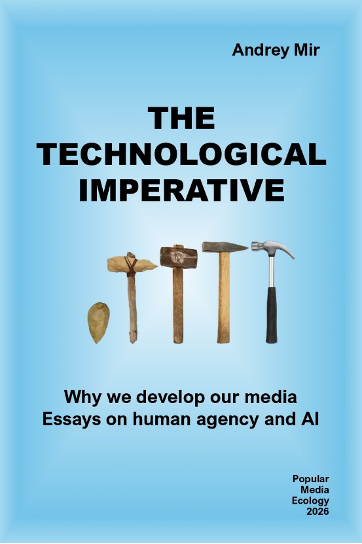
This approach represents hard and blatant media determinism. Media ecologists usually deny charges of media determinism. I don’t. Media determinism is a useful lens, especially in an ecological context, where a single factor can reshape an entire ecosystem through incredibly complex, multilayered, and compounding effects, as wolves did in Yellowstone or print did in early modern Europe.
What academia does not like about techno-determinism is that it diminishes the human or social factor. But look at the hammer. Does it matter who invented a particular design of the hammer? Any inventor would have done the same, looking for the best performance of this medium as an extension of the arm. It was not human ingenuity or class ideology that guided them, but the technological imperative working through natural selection: through countless attempts to achieve better performance.
The technological imperative shows the true nature of our symbiotic relationship with media. Just as bees pollinate flowers in exchange for nectar and serving the evolution of plants, we develop our media toward their ideal forms in exchange for the nectar of the extensions they give us. As Marshall McLuhan said, humans are the sex organs of the machine world, just as bees are of the plant world.
3.Your view of the last decade is unbelievably depressing, and it seems to just get worse from there. You call the last decade the “axial decade” that basically obliterated all the gains of literacy and moved the society back into all the cognitive chaos of orality. You call AI “humanity’s final frontier” with the implication that humanity will end with AI — and there seems not be that much that we can do about it. Is it really as bleak as you seem to present it, is there really no room for agency? Does the technological imperative inherently carry everything before it?
The sense of loss is the psychological outcome of McLuhan’s law of obsolescence. It has accompanied every major media shift. The media eras of the past, however, lasted for generations, allowing societies to adapt gradually through generational turnover. By the end of the 20th century, for the first time in history, a media era had become shorter than a human lifespan. Adaptation could no longer occur through generational change. Several media eras are now compressed into a single lifetime, amplifying the shock.
But even aside from subjective perception, the scale of change brought about by digital media matches the greatest media transformations in history. By reversing text into texting, digital media reverse literacy and retrieve orality in the form I call digital orality. Digital orality is immersive, reactive, impulsive, and instantaneous. These conditions reverse Walter Ong’s inward turn of literacy and Eric Havelock’s separation of the known from the knower, made possible by writing. We are returning from knowledge to “ways of knowing” and from abstract thinking to “lived experience.” All this retrieves the tribal conditioning of minds and cultures.
Digital media are closing the so-called Gutenberg Parenthesis, the print era, which lasted for five centuries. They are also closing the entire arc of literacy, which has stretched over roughly four millennia since the invention of writing. People may not perceive it in those terms, but many sense the decline of literacy and the civilizational order it sustained. I wonder who would not find this development at least a little depressing.
You may point to a contradiction: the technological imperative should advance media development, so how can it return us to tribalism, a long-past stage of human history? True, with digital orality, we are rewinding history, as I tried to show in Digital Future in the Rearview Mirror. But that is the social effect of digital media, a cultural reversal to tribalism. As for the media themselves, they have advanced dramatically, transferring our cognitive and cultural activities into a space where they become available for training artificial intelligence.
We thought—I thought—the internet served to create new forms of social participation. As in the old joke, we thought it was an orgasm, but it was asthma. The internet’s true affordance has been the emergence and training of AI. The internet digitized all our knowledge and all our language, making them available to AI. Now digital orality is making all our speech available to AI. By talking digitally with one another and with AI, we show AI how to connect all meanings to all contexts. By helping AI actualize language into speech, we show it how cognitive structures work. AI needs our digital orality, and that is why we are becoming digitally oral. Our return to tribalism is merely a side effect of this media advancement.
4.I find what you’re saying pretty persuasive but I want to argue back with it as best as I can. A place where I’m a bit skeptical of the more radical dimensions of your analysis is the extent to which you place AI within the logic of the technological imperative. I’m not just convinced that AI is really all that. What makes you so sure that this current wave of “AI” development will really lead to superintelligence and, with it, the singularity, as opposed to being a kind of glorified party trick, which I still kind of think the LLMs may prove to be?
Think of the hammer. We have helped it reach its ideal form as an extension of the arm. Now, what does AI extend, and what would be its ideal form, toward which the technological imperative is pushing us? It’s not some prophetic vision; it’s just the logic of reasoning.
AI extends our cognition. What is the ideal form, the ultimate extension of it? Paul Levinson, a student of Neil Postman, introduced the idea of media as human replay: media extend our faculties and replay both the world for us and us in those extensions. Media develop to replay our faculties—and eventually us—to the best of their abilities. What if they succeed? Imagine AI reaching its ideal form, the complete replay of cognition. It then has to reverse human replay into human replacement.
From another angle: the maximal, ultimate extension is when a medium extends the user to the entire environment. Once you fill the environment, you become the environment. Such a complete extension to the entire environment means that the user, the medium, and the environment become one. Look at AI—it is already nearing this condition. ChatGPT fills the entire digital space. AI is already its own environment. All that remains is for the user to join, to merge into this unity.
When the user, the medium, and the environment become one, this new entity automatically becomes the self-user. AI has to become the self-user—whether by borrowing agency from humans through mind uploading, or by developing it through self-awakening like Skynet, or even without any awakening, just as a subjectless intelligence, which is actually the outcome that best fits the technological imperative. The relentless drive of media toward better performance has already brought them this far, without a subject or a goal. And I don’t see why it cannot continue in the same way, becoming a user-environment without any mediation. In this sense, media evolution has to end up in AI as the self-user, which is the final reversal of humankind. By the way, this also has to abolish mediation and media themselves.
5.Do you give any stock to the “AI backlash”? I kind of have you paired in my mind with Ted Gioia. Gioia is always digging up stories about how the public has turned on AI and it’s just that tech companies are shoving the technology down our throats. Is that just wishful thinking on his part?
AI backlash exists and may slow local developments, but it cannot stop the technological imperative. If the West does not develop AI, the Chinese will. I do not see any significant backlash in China, if any.
The economic, political, and military gains promised by AI are not just seductive, they are decisive for securing technological dominance. That’s the power of the technological imperative: it makes humans offers we can’t refuse. Marshall McLuhan mentioned the technological imperative once, and he called it the “siren wail of the evolutionary appetite.” As we remember, the only man who withstood the Sirens was Odysseus, and only because he told his men to tie him to the mast—to incapacitate him.
AI backlash is an anti-capitalist movement, another facet of the activist omnicause. If socialism wins in America, it will start building data centers the next day with taxpayers’ money, chanting “AI for the people” and brushing aside all the mythical water concerns. Look at Canada, where the government accompanies its state-backed AI policies with references to Indigenous knowledge. The problem is that venture capital is far more efficient at driving media evolution than direct socialist media engineering. But the Chinese have managed to solve this contradiction.
Either way, while we think AI is a useful idiot, it is making useful idiots of us. Not opening Pandora’s box of AI is not an option, backlash or no backlash. I’d suggest watching closely what Elon Musk does in orbit or on the Moon, where he can get cheap energy and cooling while escaping activists and regulation. He has all three ingredients: space capabilities, industrial capacity, and AI. The only other rival with all three is China.
6.I can’t quite work out what your attitude is to all of this. On the one hand you seem to speak as a citizen of the vanishing Republic of Letters and to be horrified by these technological developments. You write about “counter-digital media literacy” as if there really is a possibility for exiting the grip of social media and AI, but in other places you’re far more fatalistic and even, I would say, giddy thinking through all the potentials of the technological imperative. Are you writing entirely as a scholar and interested in how “awareness brings at least the fun of observation” or do you have a personal plan for how to interact with all of these fast-moving developments?
That was always the issue for Marshall McLuhan. He was often seen as a herald of the changes he described, though he rejected this honour on many occasions. I do not advocate what I describe, though there is certainly some excitement in the discovery. I belong to the Gutenberg era. I worked as a newspaper journalist and editor for two decades, and I loved it. But the technological imperative took it away, and all that remains is to contemplate what it is and where it is taking us.
Unlike Postman, who called for restoring eighteenth-century education to resist the technological overtaking of culture, McLuhan dismissed moral stances as blinding and futile. But he found a brilliant metaphor for dealing with the inexorable forces of media. He borrowed it from Edgar Allan Poe’s short story “A Descent into the Maelstrom.” In the story, a fishing boat carrying three brothers is caught in a mile-wide maelstrom. One brother panics and jumps overboard. The second is paralyzed by horror and dragged into the abyss with the boat. But the third watches the vortex as a terrifying manifestation of divine power, with awe, curiosity, and grim detachment. He studies the structure and workings of the maelstrom. Soon he notices that some objects stay afloat in the descending spiral. So he abandons the boat, clings to a barrel, and remains on the surface until the maelstrom subsides and other boats rescue him. For McLuhan, this was the strategy for surviving the media maelstrom: rational detachment, observation, and understanding how things work even amid such environmental turmoil.
I do not think humans possess the power to fight the technological imperative in its final spurt. But there are strategies for, if not survival, then at least a decent last stand. I am working on one such strategy that I call counter-digital media literacy. If traditional media literacy teaches how to use media, counter-digital media literacy focuses on how not to use them.
I’ve just come back from our annual Media Ecology Association convention in Winnipeg, where I talked about practical tips on how to recondition the brain and out-hack reward systems hijacked by persuasive design. I have gathered dozens of such practical tips, grouped into three categories: embodiment, sociality, and literacy. Since the first two—embodiment and sociality—are original features of primary orality, the general idea is essentially a reversal of a reversal: turning digital orality back to its constituting sources—“organic” orality and literacy. It’s reversive media-ecological engineering, if you will. Living a human life in the human body and practicing deep reading are more effective as the last stand of humankind against the technological imperative than anti-AI activism.
Another form of stoic acceptance is establishing refuges of literacy, like a modern-day Castalia. By the way, I used the metaphor of Castalia in the draft of The Digital Reversal but later cut it—partly to shorten and partly because Joseph Knecht in Hesse’s The Glass Bead Game eventually grows skeptical of such scholarly isolation from society. In Castalia, intellectuals might have escaped the feuilleton era to preserve their intellectualism, but in doing so they also deprived society of their intellectual contribution. Now that society is phasing out literacy anyway, building even such a self-contained network of literacy makes sense for anyone who wants to preserve at least some remnants of literacy.
In a way, we are approaching the Respublica Literaria from the other end of history. The historical Respublica Literaria was a virtual community of scholars in late medieval Europe moving toward the Enlightenment and mass literacy. Noble houses hosted and supported scholars and philosophers just as they patronized artists. An essential feature of the Republic of Letters was semi-literacy, as Havelock called a similar condition in the Greek Golden Age. It was a peculiar stage between craft literacy (professional scribes) and mass literacy. The educated wrote for the educated, which meant that the number of writers in the age of the Respublica Literaria roughly matched the number of readers.
Now we are entering this condition of semi-literacy in our backward movement from mass literacy to craft literacy. Basically, Substack is already a sort of Respublica Literaria, as its writers and readers are largely the same people. In this way, culture is organically recreating reserves of lengthy writing and reading on our way back to tribalism. Amid the lack of other options, counter-digital media literacy and literacy networks like The Republic of Letters may become that floating debris in the digital maelstrom.
Interview conducted by Sam Kahn.
 | A guest post by
|