


Dear Republic,
Today we have a longform essay about a life-threatening illness by the very talented writer Will Wellman, and the moments of clarity that can accompany a personal trial of this kind.
-ROL
ONCE I WAS A WAVE
Ohhhh my body betrays me, ah but I don’t betray it back.
        — The Strange Boys, “Doueh”
A year before my kidneys failed, I stretched out across my bed and closed my eyes. I had just finished graduate school in forestry a few months before and was living at home with my mom and stepdad. There were plans to work with a conservation organization in Kenya, to live in a cabin by the Indian Ocean. Then one day my stomach hurt. Two days later my ankles doubled in size. Two weeks later I was on an operating table having my kidney biopsied.
I was diagnosed with a rare nephrotic disease and soon became a testing ground for dangerous chemicals. The medicines failed one after another after another. As the reality of renal failure dawned, I moved from my childhood bedroom into the basement. It had more space, couches, a TV. My two brothers came home one weekend, we played Thelonious Monk, and painted the walls yellow.
Those first months were the hardest. Protein escaped from my kidneys into my urine—I literally peed it out—which caused my body to retain excess fluid, at one point 50 pounds of it. (Protein lines the veins like a wall and when you lose protein fluid seeps out of the veins into the area between cells known as the “third space.”) Every time I stood up gravity went to work, pushing fluid into my lower extremities. Within minutes my ankles, calves, knees, and upper legs would swell and become so stiff I couldn’t walk.
The fluid retention caused stretch marks to break out across my thighs and stomach. Eventually the cream-pink marks became so thin fluid leaked from them. The liquid came out in clear droplets all day, the pressure inside my body so great. I put hand towels over the leaking areas and, after a few hours when they became too soaked, I would switch them out with new towels. It was as if my body was weeping.
Certain nights my heart would race and my anxious mind would dream up ways I would die that night. To deal with all of this, I would close my eyes, shut out the world, and attempt to rest in that dark, remote silence. And so, on this particular evening, I stretched across the bed in the basement, wearing an old pair of ripped khaki shorts, as cool air from the fan pressed against my bare chest. I closed my eyes.
Once I was a wave, back and forth, back and forth.
A column of water kicking up square grains of pinkish sand that stirred cyclically off the sea floor. A particular wave yet connected to an entire saline expanse.
Back and forth, back and forth.
In seconds I traced an entire turquoise ocean, traveling its furthest, emptiest reaches.
Lifetimes passed each second and yet each moment was every moment in crystalline water clearer than any tropical sea. The world washed in each wave—back and forth, back and forth—and each wave washed in the world.
The sun touched the water’s surface and scattered into beams. Each folding wave tossed diagonal shadows across the ocean floor. The earth was water and I was a wave and the sun pierced us both. Time and space were nothing but back and forth, back and forth.
I wrote in my journal that night: To be pushed by a presence until we become it.
I was initially diagnosed with a curable disease and there was hope I could beat it. My nephrologist was this big, rotund man with mossy gums; he always seemed to be on the verge of spitting out all of his teeth. He was self-assured, cocky. I didn’t realize at the time this was a terrible trait for a doctor treating a rare, complicated disease. Like Ozymandias, he stood alone in his greatness.
He put me on a high dose of steroids and told me to wait. My body ballooned with even more fluid retention. My face fattened and broke out with acne. I began to feel like some creature cursed to drown in its own body. One day I rushed to the doctor’s office without an appointment and waited hours for the doctor to tell me that, essentially, this was normal.
The following week we ran blood and urine tests. I waited for those first results with this incredible hope, this sense that these godawful steroids were working, that I would be healed… that everything would be back to normal soon. The results indicated the disease had progressed an astounding amount over the first month. Little did I know then, failure would become my norm.
During those initial months I stayed in bed, read books, and journaled. My body swelled with fluid too fast for me to do anything else. I would go to the bathroom, brush my teeth, take a shower, and then have to jump back in bed as the fluid filled my legs and turned them to pillars. I would lay in bed, a tower of pillows beneath my feet, and over time gravity would send the fluid down into my stomach and upper thighs. Later, I would go downstairs to the kitchen, make a meal, and eat. Again, my legs would swell and it was back to bed.
On top of all of this my kidneys were failing, I had high blood pressure, I was anemic. Most of the time I felt awful. And then there was the chemotherapy, which my doctor prescribed after the steroids. Hours after each treatment I would find myself in the backyard, keeled over, throwing up. The chemotherapy also wrecked my immune system and sent me to the hospital seven times in two months. Swelling from the fluid combined with a weakened immune system caused an outbreak of cellulitis, a bacterial skin infection, in my legs. The pain was so bad they initially diagnosed it as blood clots.
The first nine months were crowded with letdowns. Drug after drug, all to no avail. There were steroids, chemotherapies, immunosuppressants and none did anything. My mother, tired of it all, reached out to a renowned hospital in Boston. I fought like hell against it—I barely got out of bed those days, I was dripping fluid out of my legs, and generally felt terrible. Additionally, an antibiotic had caused severe dehydration and wrecked my stomach, causing a months-long stint of diarrhea.
After two weeks of arguing, we were on a plane to Boston. I hid my swelling with baggy clothes and squeezed my enlarged ankles into shoes with no backing. I felt like everyone on the plane was looking at me. Me the pale, swollen, sick kid.
It was February in Boston—windy and grey, temperatures dipping into the teens. Each day we ran from hotel to hospital to hotel to hospital, avoiding the biting cold as best we could. We met with the top nephrologists in the country. Every single one was overly excited to meet me, but for all the wrong reasons: I was a unique case. A rare bird as one called me.
There were dozens of appointments the first two days—poking, prodding, exploring my history, comparing case studies. The doctors decided another kidney biopsy was needed. On a cold table, for the second time, a giant needle sank through the skin of my lower back until it reached my kidney. Then a click indicating tissue from the kidney had been removed.
The evening of the biopsy Mom and I ate an early dinner and came back to the room for our nightly ritual of reading. It was horrendously cold and neither of us were in the mood to explore Boston. I had just gotten out of the shower and was lying in bed when my cell phone rang. It was an unknown number with a Boston area code. I answered and a nurse from earlier in the day identified herself.
We exchanged pleasantries and she then informed me the biopsy results were in. In that moment the astounding hope I carried, even after all the previous failures, rose up within my chest. I thought, even then, there would be good news. I waited through a long silence until she said softly, the disease has morphed into focal segmental glomerulosclerosis, which is incurable. Not knowing what else to say, I asked what this meant. You’ll have to talk to the doctors about specifics, but you’ll need to think about getting on dialysis as your kidneys are going to fail.
My first dialysis treatment was at Tampa General Hospital. Eighteen months after being diagnosed my kidneys went into complete failure—I was 26 and nearly dead. I had a new nephrologist by then and he decided we could no longer hold off dialysis and scheduled surgery. I went into an operating room and had a catheter placed in my chest, which ran a line into my jugular vein and from there into my heart. This is where they would do dialysis.
After getting the catheter, I was taken down to the first-floor dialysis unit. I had no clue what was going on, I only knew my kidneys no longer worked and dialysis would help with that. I was even more in the dark as to what exactly dialysis did or how it would make me feel or how often I would have treatments. It’s shocking to think of—being put on a treatment on which your life is dependent without any explanation whatsoever.
I was placed next to an elderly woman with a thin white tube taped to the side of her head which ran into her left nostril. It was haphazard and looked like the work of a child. The woman had these milky blue eyes that betrayed some ancient wisdom; at least that is what I thought, they could have been cataracts. I wanted her that way—ancient, wise, a keeper of secrets—because I was terrified. I wanted her to look over to me and lightly whisper we’re okay, then tell me everything I needed to know.
She never did. She didn’t even say hi, just stared past me blankly—perhaps blindly—as if I wasn’t even there. Dialysis has been much the same since—on my own, figuring it out as I go.
My brother Tyler is a doctor in North Carolina finishing up his residency in family medicine. Today after work, he calls to discuss plans for Labor Day—he’s coming down to Florida for the weekend. We talk about seeing family and fishing in between visits.
Before he hangs up, he tells me about a 36-year-old woman who died this week. She had just given birth to her second child and suffered a number of complications. She returned to the hospital four times and passed away after the fourth visit, the same night she went home. I ask him if anything could have been done, he answers with an empty voice, no, it was just a terrible set of circumstances. He explains the complications with words I can’t remember.
Tyler routinely works 80-hour weeks; last month he worked 20 days in a row. I think about him often, the amount of his life spent at work and all the death, illness, and trauma he witnesses. He tells me it wears him down, but I know he hasn’t shared the full extent of it. Regardless of all the money doctors earn, they carry so much.
After I say goodbye, I think about that woman. I think about her husband and two children who have a new life before them—one with a gaping, inconsolable absence. I think about her parents and friends, to lose someone in what is usually such a happy moment. I never knew this woman or her family and yet I’m profoundly struck by her loss—the way a life can just end and the many ripples that loss carries across the surface of relations.
What do doctors and nurses do with stories like this? Do they carry them around? Do they force themselves to forget, or explain away what happened? I wonder if any doctors or nurses carry my story—a nameless young man with a freak kidney disease and a decade on dialysis. I hope, for their sake, they don’t.
After the hospital, I began thrice-weekly dialysis treatments at a clinic down the street from my home. I regularly had migraines after dialysis. After treatments, I went down to the basement, turned off the lights, covered myself with blankets and pillows, and tried to sleep. There were also night sweats wherein I lost two to three pounds of fluid in a single evening. My body had no clue what was going on and revolted.
We began the transplant process so I could get off dialysis. My mother wanted to “go first” as she could only donate her kidney for another ten years, whereas my brothers could donate for at least another four decades. She went to a clinic where they drew vials and vials of blood. Amid all the defeats and upsets, we finally received a sign of good news: my mom was a complete match for a transplant, a rarity among immediate family. We learned this in the summer and scheduled the transplant for the first of December.
There are numerous preparations prior to a transplant. The biggest by far was the nephrectomy—the doctors decided to have my kidneys removed. This was to stave off any chance of the disease coming back in the transplanted kidney. No one knows what causes the disease I have and there is this throw-it-against-the-wall-and-see-if-it-sticks approach to preventing recurrence of the disease in transplants. One of these techniques is to remove the kidneys in hopes the disease is removed, too.
In the hospital, before being wheeled to the operating room, the surgeon came to talk briefly about the procedure. He explained everything would be done laparoscopically, using small incisions and cameras instead of cutting through the abdomen and using bare eyesight. I must have been visibly nervous because I later found out they had given me a strong dose of an anti-anxiety medicine that caused me to black out before the surgery. Usually they knock you out on the operating table, asking you to “count backward from ten;” not surreptitiously before they’ve even wheeled you back.
I awoke in the recovery room and a nurse told me a blood vessel was nicked during the surgery and my left kidney was removed the old-fashioned way with a large incision. Thankfully the right kidney was removed laparoscopically. Across my abdomen I felt 100 years of surgical advancements.
This evening there is the slightest drizzle, as if the rain is ashamed of itself. It stops and starts, always barely more than a mist. I take my dog Lily for a walk and we get two blocks down the road and the rain stops. The bright sun comes out as if it is midday. During the summer you begin to suspect the Florida sun of anger—an anger that beats down on the earth with silent indignation.
We come across a hawk bathing in a puddle beneath an oak at the park. It plays like a blue jay or cardinal would in a bird bath. I wonder if this is some gift—how rare an occasion for the hawk to bathe like that and for me to witness it. The hawk uses a single, giant wing to splash itself in this miraculous blend of utility and outright joy. It keeps an eye on us the whole time, then flies up into the oak, large and effortless.
A few blocks before getting home—it is still light out, but no longer bright—a bat flies overhead. These strange creatures are so angular and yet, somehow graceful.
As I continue to watch the bat, a peace abruptly overtakes me. Something beyond myself insists, This bat is enough, do not try to squeeze more out of it. It is as if the world has bestowed me with permission to not seek after more. I am invited to simply participate in whatever it is that goes on before me, to live within that moment alone.
A few months after the nephrectomy my mom and I went into surgery. Her kidney was removed and, moments later, placed inside my belly. It is a tremendous thing to have a piece of another person within you—something simultaneously alien and life-giving. Even more, this is from the woman who carried me inside her body for nine months. Now I would carry a piece of her inside my belly. There was an incredible sense of pressure for the kidney to work, for the disease not to return—events over which I had no control.
I awoke in an ICU room after the surgery; my blood pressure skyrocketed dangerously high during the procedure. I knew immediately the disease was back. It wasn’t anything physical, just a sudden intuition. I didn’t tell anyone at first, even those relaying communications between my mother and me, rooms apart with our newly wounded bodies. Amid the swirling joy of those around me, I held my secret close.
Within days lab tests confirmed the disease had in fact recurred. Incredibly, the disease was more aggressive than it had been in my native kidneys. A doctor on the transplant team told me it was the second worst recurrence they had ever seen. Now the entire family shared my dark secret. There are no words to describe how I felt then. Empty, hollow, defeated come close.
Each day I laid in a hospital bed staring at the wall before me, running through images of the life that awaited me, a life I did not want to lead. I didn’t allow any visitors besides immediate family—I couldn’t deal with the good-intentioned pep talks people give when they’re nervous. I rarely talked; though I knew I was not to blame, I couldn’t process the reality that the kidney my mom gifted me was dying and would soon be removed.
Three weeks after the transplant, my nephrologist scheduled a biopsy to determine how much scarring had occurred in the transplanted kidney. A third biopsy—this time the giant needle entered through my stomach where my mother’s kidney had been placed. I remember laying on that table indifferent to the world, wholly apathetic. I didn’t need a biopsy to tell me what I already knew. Though I was awake for the procedure, it was as if I was out cold, staring lifelessly at the tiled ceilings above.
The night after the biopsy, my brother Tyler visited. He had been sleeping at the hospital most nights, leaving at lunchtime and returning after dinner. Tyler had just come back from our childhood church where an impromptu prayer service had taken place. He told me about the service and the people that came up to him and asked about me. And then he recounted how friends and family crowded the church’s chapel until it overflowed, dozens crowding around an open door as the pastor prayed for my healing.
When he finished telling me this, I said I needed to brush my teeth. I got out of the hospital bed and calmly walked to the bathroom. Once inside, I came to the sink, looked at myself in the mirror, and then turned the sink on full blast. As the water burst forth, I broke down, crying uncontrollably, sobbing my guts out. All I could think was I of all people do not deserve this love.
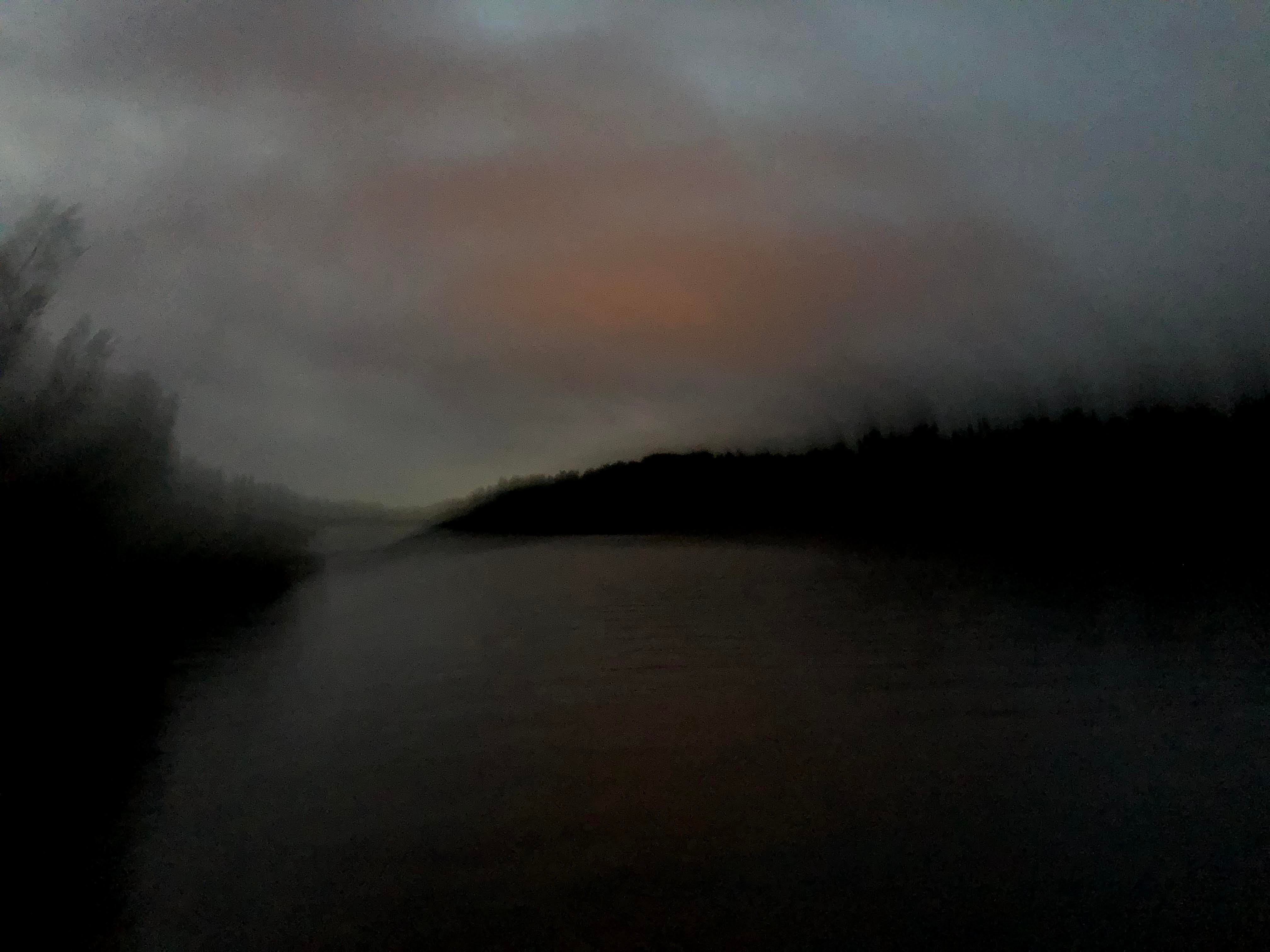
Tonight the eastern sky is dark and the west too, except for a hole in the clouds out of which evening’s last light escapes. It is literally a hole and through it I catch the slightest glimpse of sunset, the earlier soft pinks and reds have burned to darker shades. Night is near.
I walk down the street and take the sunset in, thankful for that small glimpse. Earlier today I thought of my friends, the many ups and downs they have faced. I thought of their bodies, healthy and in good shape, especially for our age. It has been 12 years since I was first diagnosed, and 10 since starting dialysis. There are days when I wonder how much longer my body can handle dialysis, how much longer until my body gives up and dies.
When I get home, I read section four of George Seferis’ poem, “On a Ray of Winter Light” from Three Secret Poems—
Years ago you said:
‘Essentially I’m a matter of light’
And still today when you lean
on the broad shoulders of sleep
or even when they anchor you
to the sea’s drowsy breast
you look for crannies where the blackness
has worn thin and has no resistance,
groping you search for the lance—
the lance destined to pierce your heart
and lay it open to the light.
Will Wellman is an essayist and poet living in Nashville, Tennessee. His nonfiction has been included in Longreads‘ “Best of Science and Nature” and Best Spiritual Literature. He is at work on his first book.
 | A guest post by
|
Wonderful piece. Profound and poetic. Reading it, I got angry at the universe. Then the sections on waves, rain, birds and sky eased that anger a bit. Get that book done, man!
Even knowing this story couldn’t have prepared me for reading how you recount it — through a beautifully vulnerable, painful truth you allow us to feel. Your words took my breath away, brought me to tears, made me question and hope and hurt all at once. The world is so lucky to have you in it. Your words are undeniably special and deeply impactful — and yet only amount to a fraction of how special and impactful you are as the one who crafted them amidst your suffering. Thank you for sharing so honestly. I will keep looking out for more of your words to come.