


Dear Republic,
This piece is a treat. ROL has been wondering for quite a while what the hell ‘worldbuilding’ is — where it came from and how it seemed to take over everything, with our high school English teachers saying nary a word about it. And now — with Craft/Complaints Week tilting nicely over in the direction of Craft — Lillian Wang Selonick answers the question for us.
-ROL
WORLDBUILDING
Too much of today’s speculative-lite literary fiction reads like someone binge-watched Black Mirror, skimmed a Wikipedia page on AI, and called it a novel. This is what happens when the gates of the sci-fi ghetto open and the literary mainstream comes slumming without learning the local customs.
Take “worldbuilding”—a term once confined to the nerdy margins of genre fiction. Now it’s everywhere. The r/Worldbuilding subreddit has 1.8 million members, placing it in the top 1% of all Reddit communities. Merriam-Webster added the word to its dictionary in 2023 (“the creation of a fictional world… that is believable and consistent within the context of the story”). A niche technical term has gone fully mainstream, applied to novels, movies, video games, and prestige TV—by critics, fans, and insufferable plot-hole sleuths alike.
Where did this concept come from? And why has it become so ubiquitous?
The Rise of Worldbuilding
The phrase first appeared in 1820 in the Edinburgh Review to describe the imaginative powers of writers and artists. In 1965, it appeared in a work of criticism about Edgar Rice Burroughs (author of the John Carter-starring Barsoom series and Tarzan series), and subsequently would be used in limited academic settings to describe the worlds of Dune by Frank Herbert, The Lord of the Rings by J. R. R. Tolkien, and other lush science fiction and fantasy universes.
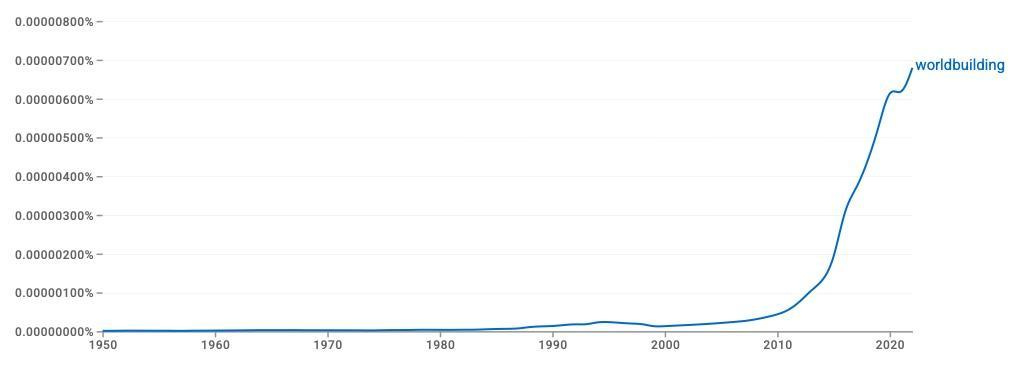
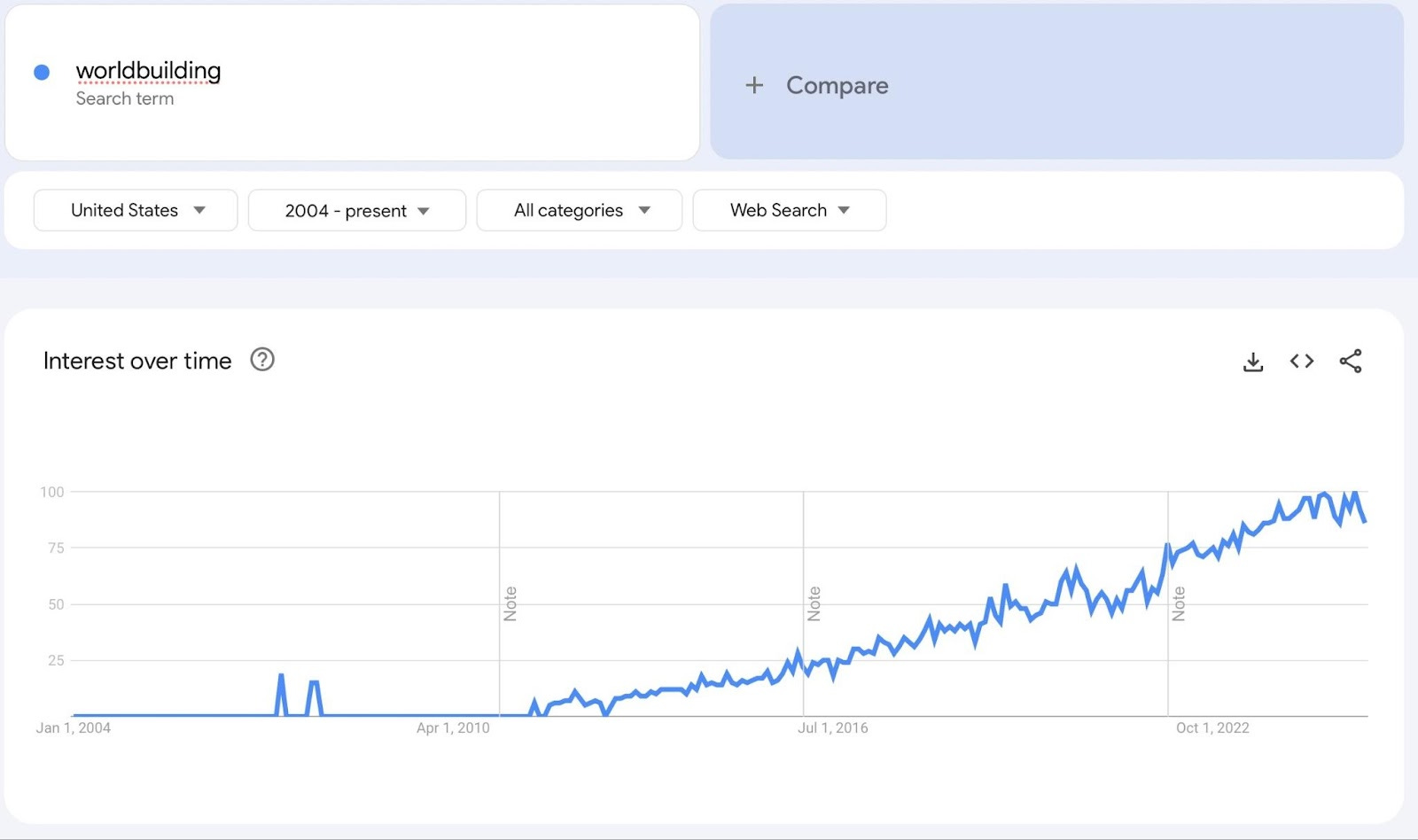
The word’s appearance in books begins to rise around the turn of the millennium, but it doesn’t become ubiquitous until the mid-2010s. Google search interest for “worldbuilding” picks up around this time.
Worlds Without Stories
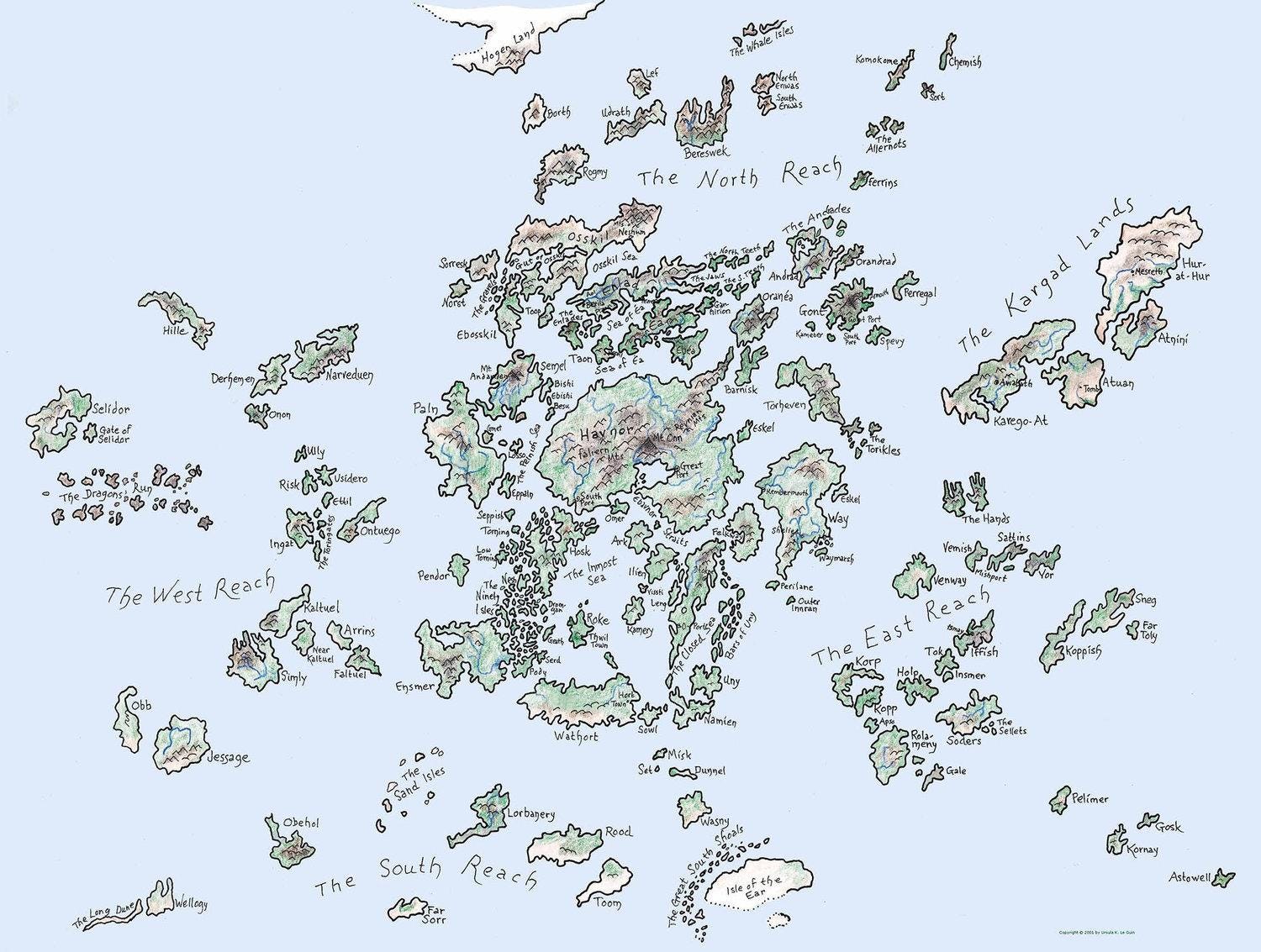
I first encountered the concept of worldbuilding around 2012, through a student club of the same name founded by my friend Roy Salzman-Cohen. We’d met in our first-year humanities seminar on Ancient Greek Thought and Literature. The mission of the club was simple: construct a fully realized secondary science fiction world—its geography, flora, fauna, customs, currencies, and politics—and then write stories set in it.
Our meetings took place late on Wednesday nights in a drafty classroom. We argued passionately about sandworms: should they exist? (I voted yes.) If so, how big, how dangerous, how intelligent? Roy had a gift for channeling our nerdy bickering into real progress. Slowly, our world came together. It was thrilling. And then it was time to write.
I choked. Despite all our meticulous planning, I couldn’t come up with a story. The world was rich, but I had no entry point. The few pages I managed to write were so embarrassing I stopped showing up to the club.
That experience stuck with me. It was my first lesson in how easily worldbuilding can become an end in itself—an elaborate scaffolding that never supports anything. For me, building a world before writing a story wasn’t liberating; it was paralyzing. But I’ve also learned that writing into a void—without any world at all—can be just as fruitless.
Against Worldbuilding?
The rising use (and overuse) of the term led to a brief literary dustup in 2017 prompted by Lincoln Michel’s provocative essay Against Worldbuilding. Michel argues that worldbuilding is only useful in some very specific science fiction/fantasy secondary world contexts, and that an over-reliance on top-down, nuts-and-bolts fictional universe engineering is tedious and unnecessary in the vast majority of cases. Instead, he argues convincingly for something he calls world-conjuring, which is the light-handed use of evocative details that allows the reader’s imagination to fill in the logic of a fictional world.
The essay triggered a slew of responses from worldbuilding’s defenders. In a follow-up essay, Michel clarifies:
My argument is that worldbuilding is overrated and overused. That a concept that’s useful for certain kinds of fiction (such as epic second world fantasy or role-playing games that require clear rules for gamers to follow) is being inappropriately applied to all fiction genres. That expectations for worldbuilding in all genres have become a problem, causing readers (and critics) to focus on background details while missing the essential aspects of a story and leading to quick dismissals of different fictional modes.
What accounts for the attraction of worldbuilding? For writers, worldbuilding can be a particularly powerful form of procrastination and avoidance. It’s an absorbing activity that is not writing, but can be defended as necessary for the writing. There is an intoxicating power to it; every writer can become the watchmaker god of his own creation. The impulse to play god can easily overwhelm narrative.
More broadly, the obsession with ensuring that our fictional universes have bulletproof logic strikes me as a feature of our growing impatience and imaginative laziness. In the 1950s, you could see the zipper on the monster suit in the movie, but viewers were willing to suspend their disbelief and feel real fear. Audiences understood fiction to be a collaborative act between director and moviegoer, author and reader. With AI-powered CGI, anything less than perfect verisimilitude in our monsters takes us out of the moment. We expect all aspects of our fiction to be spoon-fed to us, with no room for ambiguity or inconsistency. Rather than build a bridge between our minds and the page, we expect every detail to be worked out for us in advance.
However, a misuse of worldbuilding can be just as deadly as its overuse. While I agree with Michel that most forms of fiction don’t require a Silmarillon-level appendix of lore to be successful, I’d argue that for genre-straddling literary fiction, a common point of failure is a deficit of care taken to flesh out the speculative setting or elements and make them matter. Literary fiction authors who dabble in speculative themes and sci-fi vibes pick up their ideas about worldbuilding from the ambient visual culture, rather than through specific works that are deeply rooted in the genre. This grants their books the veneer of sci-fi without its substance. The problem isn’t that worldbuilding has gone mainstream—it’s that it’s being used to decorate, not to create.
From Fringe to Prestige
The rise of worldbuilding is a distinct but related corollary to the growing dominance of nerd media in popular culture. Like many passionate nerds who grew up reading science fiction in the ‘90s and earlier, I have a chip on my shoulder when it comes to genre. For the first half of my life and many decades before I was born, speculative fiction had been relegated to the ghetto of genre in American literary life. The mainstream literary establishment in this country has long condescended to writers and readers of science fiction, decreeing a sharp divide between them and those of “serious” literary fiction.1
Just as mainstream popular culture has been thoroughly colonized by nerd culture—think of the reach of Game of Thrones or the Marvel Cinematic Universe—so too is the literary mainstream finally taking on characteristics of the genre ghetto. Over the past decade or so, it has gradually become acceptable, and even fashionable, for authors who are otherwise firmly in the literary/realist camp to incorporate speculative premises, settings, and flourishes to their work, often without thoughtful engagement with the traditions or history of the genre. This is an intuition I’ve had as a casual observer of literary movements, so I went looking for evidence to prove (or disprove) my hypothesis.
There have always been a smattering of speculative works that break through and become celebrated for their literary merit. Think of Brave New World, 1984, and The Handmaid’s Tale. But these exceptions are rare. And none of them are written by an American. Looking at the National Book Award and Pulitzer Prize winners and finalists since the 1950s, there is precious little speculative fiction until the 2000s (Vonnegut and Pynchon being, maybe, honorable exceptions).
After that, there’s a deluge. In 2007, The Road by Cormac McCarthy, a post-apocalyptic travel novel, won the Pulitzer Prize for Fiction. In 2014, the post-apocalyptic pandemic novel Station Eleven by Emily St. John Mandel was a finalist for the National Book Award and won the 2015 Arthur C. Clarke Award. In 2016, alternate history novel The Underground Railroad by Colson Whitehead won the National Book Award, the Pulitzer Prize, and the Arthur C. Clarke Award. In 2021, Anthony Doerr’s Cloud Cuckoo Land was a National Book Award nominee. The dystopian Chain-Gang All-Stars by Nana Kwame Adjei-Brenyah was nominated in 2023. We can also add works by Jonathan Lethem, Michael Chabon, Adam Johnson, Charles Yu, Jessamine Chan, Gina Chung, and Jinwoo Chong to the list.
Meanwhile in the UK, Kazuo Ishiguro’s 2005 clone coming-of-age novel Never Let Me Go initiated this modern era of genre-bending by being shortlisted for the Booker Prize and winning the Arthur C. Clarke Award. More recently, Ishiguro’s dystopian AI android novel Klara and the Sun was longlisted for the 2021 Booker Prize, Prophet Song by Paul Lynch won the 2023 Booker Prize, while Samantha Harvey’s astronaut novel Orbital won in 2024.
I’ve read a handful of these hybrid books, and while I enjoyed many of them, most of them trigger my latent sci-fi nerd hackles. They each incorporate speculative elements, but none of them read like speculative novels. These authors, on the whole, fail to engage with the rich tradition of speculative fiction, instead choosing to sprinkle in sci-fi tropes and premises that they absorbed through osmosis and Black Mirror exposure, rather than learned through the obsessive study of Asimov, Herbert, and Clarke. As an embittered old head, I bristle at how sci-fi tropes are used as seasoning on otherwise bland literary plots. These books fail as speculative fiction because they don’t strike the right balance of worldbuilding vs world-conjuring, to use Lincoln Michel’s term.
The Virtues of the Genre Ghetto
American science fiction authors with literary ambitions—like Philip K. Dick, Ursula LeGuin, and Harlan Ellison—long lamented the ghettoization of the genre. I think this metaphor is instructive.
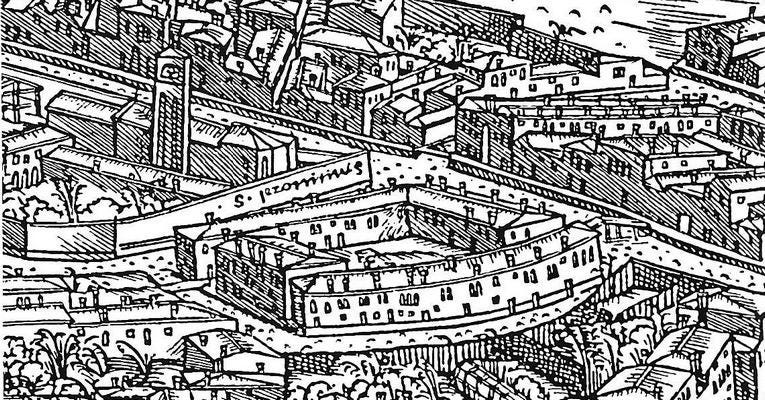
The first ghetto was established in Venice in 1516 as a way to segregate the city’s Jews and to ensure that no gentile would be sullied by suffering the presence of a Jewish neighbor. Jews were required by law to live in a tiny, walled district. They were permitted to enter the main city during the day and required to return at night, when the ghetto gates were locked. Wealthy merchants and impoverished peasants alike were forced to cohabitate in dense, unsanitary conditions.
The practice spread throughout Europe and in the latter half of the second millennium almost every major European city had a Jewish ghetto. In the post-Enlightenment era of Jewish emancipation, the ghettos were mostly abolished and Jews were gradually allowed to assimilate into European Christian society. During the Holocaust, the indignities were reprised a thousandfold with the opening of ghettos in cities where many Jews had lived freely for decades or centuries.
The ghetto tends to be remembered with deep shame and loathing. But this isn’t the only interpretation of the place of the ghetto in Jewish history. Recently, I’ve been watching a lecture series from the Great Courses, Jewish Intellectual History: 16th to 20th Century by David B. Ruderman. Professor Ruderman argues convincingly that, while the imposition of the ghetto was obviously an injustice that reduced the quality of life for many thousands of Jews, the Venetian ghetto paradoxically created the conditions for Jewish life to flourish and interact with Christian and secular institutions more fruitfully than if the Jews had been dispersed throughout the city.
In Ravelstein, Saul Bellow’s Abe Ravelstein (a stand-in for Allan Bloom) insists that the contemporary colloquial usage of the word ‘ghetto’ for areas of urban blight is a misapplication of the original meaning, and that it unfairly maligns the ghetto Jews. When his (Chinese) companion, Nikki, tries to explain away a (presumably Black) nurse’s uncouth behavior by claiming that “they’re from the ghetto,” Ravelstein is indignant. “‘Ghetto nothing!’ Ravelstein said. ‘Ghetto Jews had highly developed feelings, civilized nerves—thousands of years of training. They had communities and laws. ‘Ghetto’ is an ignorant newspaper term. It’s not a ghetto that they come from, it’s a noisy, pointless, nihilistic turmoil.’” Many layers of racial dynamics to unpack here!—but the salient point for my clumsy analogy is that, in specific circumstances, the ghetto served as a crucible for the formation of a strongly ordered Jewish society.
At the risk of offending just about everybody, I argue that something similar was at work in the speculative fiction ghetto that was tightly locked throughout the 20th century. High and lowbrow writers, pulp slingers, Golden Age and New Wave; while they may have fought bitterly amongst themselves, these writers were all locked in an ecosystem that flattened their distinctions to everyone outside of the walls. Fine-grained subgenres were allowed to thrive in the shade of The New Yorker’s indifference. The Venetians didn’t care if you were Ashkenazi or Sephardic, Orthodox or secular; a Jew was a Jew, and he belonged in the ghetto. Hard sci-fi or alternate history? Don’t care; get in the ghetto.
Science fiction and fantasy authors had the luxury of being completely ignored by the mainstream literary community, and thus could afford to take risks and develop a vibrant culture that would have been impossible had these writers been jockeying for the National Book Award.
Escaping the Ghetto
But in the last 20 years, something different has been happening. The warders of literary fiction have been leaving the gates unlocked at night. As the world around us grows ever more sci-fi, the line between realist and speculative begins to blur. As William Gibson said, “The future is already here. It’s just unevenly distributed.”
There’s no going back. Even if it were possible to recreate the conditions in which Golden Age sci-fi thrived, I’m not sure we’d want to. Even cynical snobs like me can admit that it’s kind of cool that the Villeneuve Dune movies were the biggest cultural events of the years they came out, even if we have some quibbles with the directorial choices. (They’re heavy on the -conjuring, light on the -building.)2
I’ve argued previously that more science fiction deserves to be treated like serious literature. But the ghetto gates open both ways. Much of the contemporary literature now dabbling in speculative tropes doesn’t deserve to be treated as serious science fiction. I remind myself that even in the Golden Age of the genre, most of what came out of the sci-fi ghetto was bad. This is true of every medium and every era. We remember the standouts only because time lets us forget the rest. The best science fiction builds worlds not to escape reality, but to better interrogate it. I remain hopeful that, amid the flood of speculative-lite novels chasing literary prestige, a few might still surface to offer the best of both worlds.
Lillian Wang Selonick is a writer and science communication professional in the Washington, DC region. She writes about classic literature and science fiction on Substack at The Lillian Review of Books. She is at work on a novel; her published short fiction can be found at lillianwangselonick.com.
Interestingly, this has not been as true in Europe. In a 1976 interview, Philip K. Dick commented on his popularity in Europe, postulating that Europeans are more receptive to the novel of ideas, of which the science fiction novel is the purest distillation.
No mention at all of CHOAM? No Spacing Guild Navigators? No banquet scene from the Atreides’s arrival on Arrakis?!
 | A guest post by
|
Away from sci-fi and fantasy, there are many novels that build worlds. O'Hara's Appointment in Samara builds a world of a 1930s small town on coal country PA with great skill and economy.
This is very good! Thanks for writing it.
Really interesting to me that the term "world building" only gained notoriety in the past 10-15 years. I've always been a big fan of both SFF and literary fiction, so I've liked seeing the recent convergence. But part of it has also frustrated me, though I couldn't place my finger on why. This essay really helped -- I want to see literary aspirations and qualities grafted onto SFF, not the other way around.
The other thing about "world building" I've been thinking is that we need to bring back the prologues and info dumps. It became very fashionable at some point to do a kind of stealth world building, where pertinent details are weaved into dialogue and plots and actions, instead of just giving several paragraphs or pages of explanation. This is a TV/film trick, and I think literary worldbuilding could use a bit more straightforward explanation. I've heard from some non-SFF fans that "I don't understand what's going on and it makes me feel stupid" is a frequent barrier to reading in the SFF genre.